By Watson Scott Swail, President/CEO & Senior Research Scholar, Educational Policy Institute
For generations, higher education leaders have advanced a compelling value proposition: college graduates earn more, experience lower unemployment, and enjoy greater career opportunities than individuals without postsecondary credentials. That argument remains largely true. Yet provosts and chief academic officers increasingly find themselves responding to a different and more complicated question:
Is higher education creating enough value for students, institutions, employers, and society to justify its rising costs and growing complexity?
This question lies at the heart of The ROI of Higher Education, a new book that brings together economists, university presidents, policy experts, and researchers to examine educational value in an era of affordability concerns, demographic shifts, technological disruption, and workforce transformation.
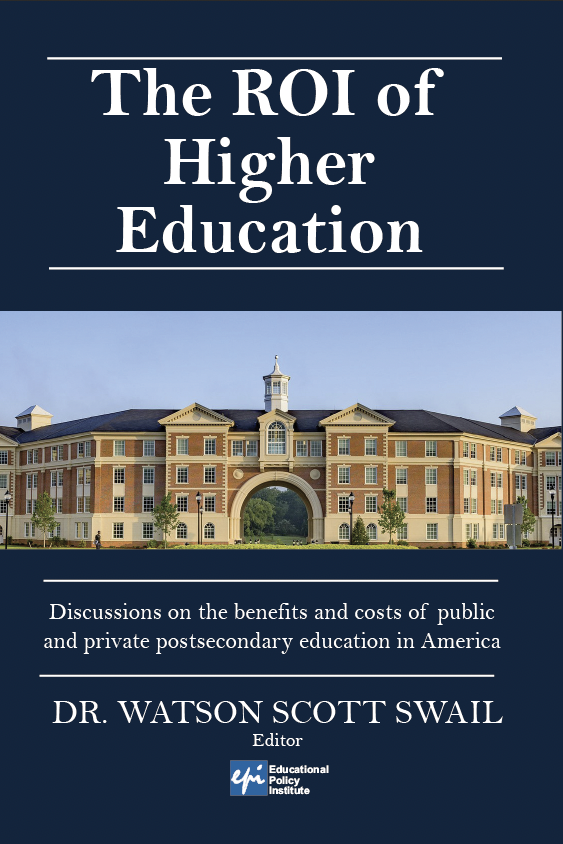
For academic leaders, the book’s message is both encouraging and cautionary. Higher education remains one of society’s most powerful engines of opportunity and mobility, but institutions can no longer assume that stakeholders will accept that value proposition without evidence. Increasingly, colleges and universities must demonstrate how learning translates into student success, workforce readiness, and societal impact.
We Have Entered the Era of ROI Accountability
The public conversation about higher education has shifted. Students increasingly ask whether a degree will lead to meaningful employment. Legislators demand evidence of workforce relevance. Employers question whether graduates possess workplace-ready competencies. Families want assurance that educational debt will lead to opportunity.
At the same time, institutions face declining demographics in many regions, increasing skepticism about tuition costs and growing competition from alternative credentials. These pressures are reshaping expectations about institutional performance.
As Peter Smith argues in the book, the traditional campus-centered model of measuring value is being disrupted. Stakeholders now expect evidence not only of enrollment and completion, but of learning outcomes, workforce readiness, skill acquisition, and long-term career success. For provosts, this means ROI can no longer be viewed as a financial discussion occurring outside academic affairs. It has become both an academic-quality issue as well as a workforce-alignment issue.
The Earnings Premium Still Matters
Despite growing criticism of higher education, the economic evidence remains robust. Research reviewed throughout the volume shows that college graduates continue to earn substantially more than high school graduates over their careers. Estimates reviewed in the book indicate that bachelor’s degree holders may earn hundreds of thousands to more than a million dollars in additional lifetime income compared to workers with only a high school diploma. And these data often do not include other, financial-related indicators such as investment income and retirement flexibility.
Of course, there are other substantial benefits to a higher education reflected by lower unemployment rates, greater employment stability, increased access to benefits/health care, stronger opportunities for career advancement, and a greater adaptability in changing labor markets.
The problem is not that higher education has lost value: the problem is that value has become more variable. We have found is that it isn’t simply if someone went to college or if they earned a credential. The returns also vary dramatically by what college they attend, what major they choose, and even the geographic region of their institution. On the other side of the formula, the cost of attendance plus labor market conditions have a great impact on the returns on investment.
I have worked with college leaders for three decades via workshops and conferences exploring issues related to college access and success, with a specific focus on completion and students who are historically underrepresented in higher education. For the provosts and chief academic officers, there is a crucial importance in not only attracting and matriculating students to their colleges, but ultimately ensuring that these students complete degrees and have meaningful post-college opportunities.
Completion Is the New ROI Frontier
One of the strongest themes emerging from the book is that noncompletion represents the greatest financial risk in higher education. Students who stop out accumulate costs and debt but often fail to realize the labor-market benefits associated with degree attainment. My colleague Tom Mortenson has always said, “The only thing more expensive than going to college is not going to college.” It is easy to hang on to this caveat, but it becomes a little less true each year as the cost of attaining a college degree continue to escalate far beyond inflation. My belief is that, for some students, the associated cost of going to college and not completing can land them in a position worse than if they didn’t go at all. This is a problematic thought and I don’t think any of us wants to believe it. However, our high cost, high aid higher education system has increased the risk of attendance for many students.
For our academic officers, this is a clear message that degree and certificate completion are critical for institutional success. The days of simply providing a “quality” education experience isn’t enough anymore. Providing intrusive advising, tutoring, mental health services, childcare support, emergency grants, transportation assistance, and structured pathways are the new requirements for wrap-around services for college campuses. Put another way, these are the new ROI strategies.
In The ROI of Higher Education, James Applegate argues that institutions must move beyond an access-focused model toward a completion-focused framework that recognizes the complex barriers faced by contemporary learners, particularly low-income students, adult learners, first-generation students, and students of color.
For many colleges, improving completion rates may provide a larger ROI impact than launching entirely new academic programs.
The Skills Question Is Becoming Central
Employers consistently identify communication, critical thinking, teamwork, adaptability, and problem-solving as among the most important workplace competencies. Yet many hiring systems continue to rely heavily on degrees as screening devices, creating tension at the center of higher education which begs this question: are institutions preparing graduates for careers, citizenship, and lifelong learning, or simply awarding credentials?
Several contributors argue that future success will depend on better documenting and demonstrating competencies as part of the ROI of a college education. Peter Smith suggests that emerging approaches to outcomes assessment, competency-based learning, and evidence-based credentialing may help bridge the gap between academic achievement and workforce readiness.
For provosts, this raises important questions:
- Can graduates articulate what they know and can do?
- Are learning outcomes transparent?
- Is employer feedback systematically incorporated into curriculum design?
- Do transcripts sufficiently communicate competency?
Increasingly, the answer to ROI may depend on how effectively institutions answer these questions.
Work-Based Learning May Be the Missing Link
One of the most consistent findings across the volume is the importance of experiential learning. Internships, apprenticeships, undergraduate research, clinical placements, employer-sponsored projects, and cooperative education experiences consistently strengthen post-graduation outcomes. Yet participation in these experiences remains uneven.
The ROI challenge is not simply to expand work-based learning, but to ensure that every student can participate—not only those with the financial means and flexibility to do so. Many full- and part-time students work to support their families and education, limiting access to internships and similar opportunities.
This creates both an equity challenge and a strategic opportunity. If experiential learning improves employment outcomes and career readiness, institutions can no longer treat it as an optional enrichment activity. It must become an integral component of the undergraduate experience.
This barrier can become a critical dividing line in whether higher education advances their careers.
ROI Is Bigger Than Salaries
Perhaps the most important insight from the book is that ROI cannot be reduced to income alone. Michael Filimowicz and Veronika Tzankova argue for a holistic framework that recognizes educational returns across multiple dimensions, including economic, civic, cultural, and personal outcomes. Similarly, several authors document associations between educational attainment and:
- Better health outcomes
- Higher civic participation
- Greater volunteerism
- Increased social mobility
- Expanded professional networks
- Improved quality of life
These outcomes may be difficult to quantify, but they remain central to the mission of higher education. The challenge for academic leaders is balancing economic accountability with broader educational purposes.
A Strategic Agenda for Provosts/CAOs
Across the volume, several practical priorities emerge for academic leadership:
1. Focus relentlessly on completion. Access without completion creates risk rather than opportunity.
2. Strengthen program-level outcomes data. Students increasingly expect transparent information about costs, completion, employment, and earnings. So do employers.
3. Expand work-based learning. Experiential education should be integrated into every academic pathway whenever possible.
4. Align curricula with both competencies and careers. Workforce relevance and liberal learning need not be competing goals.
5. Support underserved learners aggressively. The greatest gains in educational value may come from improving outcomes among students who have historically faced the greatest barriers.
6. Measure public value broadly. Success should include mobility, learning, civic engagement, and societal contribution, not earnings alone.
The Bottom Line
The question facing higher education is no longer simply whether college is worth it. For most graduates, it still is. The more important question is whether institutions can continue to create meaningful value in an environment of rising expectations, tighter resources, demographic shifts, technological disruption, and increased public scrutiny.
The contributors to The ROI of Higher Education arrive at a fundamentally optimistic conclusion: higher education remains one of society’s most important investments. But maintaining that value requires institutions to focus less on enrolling students and more on ensuring that learners acquire capabilities, complete credentials, transition successfully into careers, and contribute meaningfully to their communities.
Over the next decade, the most successful institutions will not necessarily be those that enroll the most students or award the most degrees. They will be the institutions that create the greatest value for the students and communities they serve.
The ROI of Higher Education is available at amazon.com
Dr. Watson Scott Swail is the President/CEO & Senior Research Scientist of the Educational Policy Institute (EPI). Founded in 2002, EPI is a non-profit, non-partisan research organization dedicated to advancing educational opportunity, access, and student success. EPI works with policymakers, educators, institutional leaders, and community stakeholders to address some of the most pressing challenges facing education today.


