
By Watson Scott Swail, President/CEO & Senior Research Scholar, Educational Policy Institute
For decades, international students have been a cornerstone of American higher education, helping universities fill classrooms, sustain graduate programs, conduct cutting-edge research, and generate billions of dollars in tuition revenue. Today, however, a combination of restrictive immigration policies, declining student mobility, and growing uncertainty about studying in the United States is creating one of the most significant challenges the sector has faced in years. The cost of these losses will be in the tens of millions for individual institutions and hundreds of billions for the US economy as a whole. This issue has a potential to recast higher education in America and potentially reduce educational opportunity.
Recent federal policy changes have intensified concerns that the United States may be becoming a less attractive destination for international students. In July, the Department of Homeland Security finalized a rule ending the decades-old “duration of status” policy that allowed international students to remain in the country as long as they were making satisfactory progress toward their degree. Under the new system, most students will be limited to a four-year stay and will need to apply for extensions if they require additional time to complete their programs. The rule also restricts transfers and changes of major during a student’s first year and reduces the post-graduation grace period from 60 days to 30 days.
Administration officials have argued that the changes strengthen national security and prevent abuse of the student visa system. Critics, including higher education organizations and immigration advocates, contend that the policy creates new layers of bureaucracy while doing little to address actual problems. They point out that many doctoral, medical, and research-oriented programs routinely take longer than four years to complete, potentially forcing thousands of students into repeated extension requests simply to finish their education.
The policy shift comes at a time when international enrollment was already showing signs of weakness. The Institute of International Education (IIE) Open Doors data cited by higher education researchers found that new international student enrollment fell 7.2 percent during the 2024–25 academic year, while preliminary fall 2025 data showed a much steeper 17 percent decline in new international enrollment. Universities overwhelmingly cited visa delays, visa denials, and concerns about the United States becoming a less welcoming destination as key factors behind the downturn.
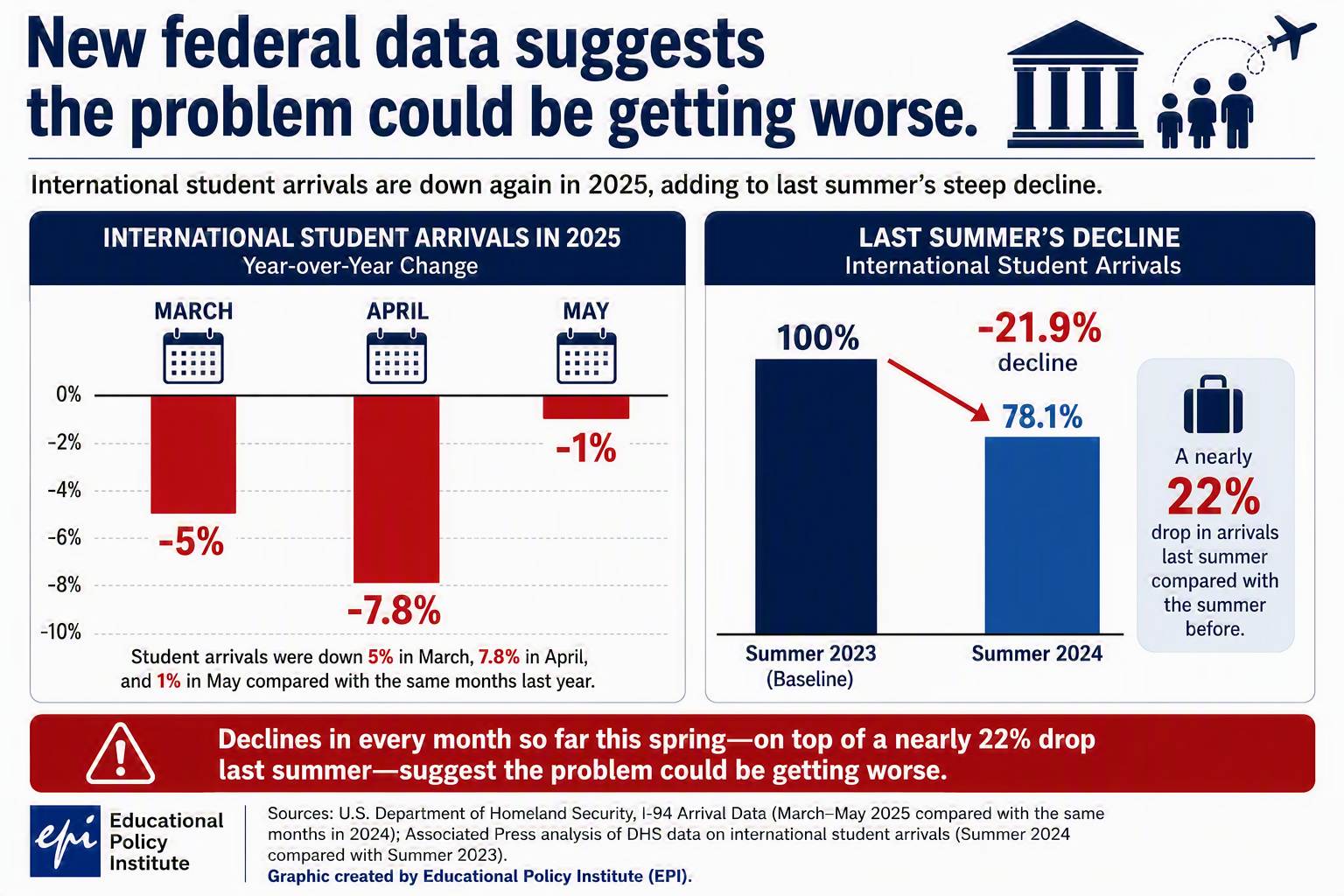
New federal arrival data suggest the challenges may be continuing. According to the U.S. Department of Commerce’s I-94 arrivals data, student arrivals were down 5 percent in March compared with the same month a year earlier, declined nearly 8 percent in April, and fell another 1 percent in May. Those reductions follow an even more dramatic decline the previous year, when the number of international students arriving in the United States during the summer dropped by nearly 22 percent compared with the prior summer. These figures point to sustained weakness in the international student pipeline and reinforce concerns that enrollment declines may continue into future academic years.
The impact is especially pronounced in graduate education. International graduate enrollment exceeded 500,000 students in 2023–24 and had become a crucial source of growth for many institutions. Yet the sector has now entered a period of contraction. International graduate enrollment declined 2.7 percent between 2023–24 and 2024–25, and more recent data indicate further losses. Some surveys reported declines approaching 20 percent in new international master’s enrollments, while spring 2026 enrollment figures showed additional drops in graduate student headcounts.
This trend is particularly troubling because graduate programs depend heavily on international students. Many STEM fields—including engineering, computer science, and data science—enroll large proportions of students from abroad. International students also play critical roles in research labs and doctoral programs that support innovation across the U.S. economy. As enrollment falls, universities face both financial and academic challenges.
Another source of vulnerability is the concentration of international enrollment in just two countries. India and China account for roughly three-fifths of international graduate students in the United States. Although India recently surpassed China as the largest source of international students, both markets are showing signs of instability. Chinese enrollment has been gradually declining, while policy uncertainty and increased scrutiny of Chinese students have raised additional concerns. Analysts also caution that colleges may be overly dependent on continued growth from India at a time when visa restrictions and competing destinations are reshaping student mobility patterns.
Universities have increasingly looked toward emerging markets such as Nepal, Pakistan, Bangladesh, Ghana, and Zimbabwe to offset losses from India and China. While these countries offer opportunities for diversification, experts note that they generally produce smaller student populations and can be less predictable sources of enrollment. As a result, they are unlikely to fully compensate for declines among the traditional leaders in the near term.
The financial consequences are already becoming visible across higher education. Institutions that built graduate-school expansion into their long-term business models are now being forced to reassess their strategies. Reports from around the country describe layoffs, hiring freezes, academic program reviews, budget cuts, and enrollment-management initiatives designed to offset declining international tuition revenue. Universities that once relied on steady growth in graduate enrollment are now confronting a far less predictable environment.
The implications extend beyond campus budgets. International students contribute significantly to American research, entrepreneurship, and workforce development. Higher education leaders warn that sustained declines could weaken the nation’s ability to attract top global talent in science, technology, medicine, and other high-demand fields. Organizations representing colleges and universities argue that the United States risks losing ground to competitors such as Canada, Australia, and several European countries that actively market themselves as welcoming destinations for international students.
Universities are responding by adapting recruitment strategies, expanding geographic outreach, strengthening support services, and developing contingency plans for future enrollment disruptions. Many are also focusing more heavily on retaining current international students and encouraging international undergraduates to continue into graduate studies. Analysts increasingly argue that institutions can no longer treat international enrollment as a guaranteed source of growth and must instead plan for a more volatile future.
For American higher education, the stakes are substantial. International students have long enhanced campus diversity, supported research excellence, and contributed vital revenue to universities nationwide. As new visa restrictions take effect and enrollment indicators continue to weaken, colleges are entering an era defined less by expansion and more by resilience. The key question is whether policymakers and institutions can reverse current trends before temporary declines become a lasting transformation of America’s position in the global education marketplace.
References
Alonso, Johanna. “Homeland Security Limits How Long International Students Can Stay in U.S.” Inside Higher Ed, July 16, 2026. Used for information on the Department of Homeland Security’s final rule ending duration of status, the four-year visa limit, stakeholder reactions, and anticipated impacts on international enrollment.
Gardiner, Chris. “International Graduate Enrollment: From Boom to Reckoning.” Encoura Wake Up Call, May 15, 2026. Used for data on graduate enrollment trends, international student market concentration, and institutional adaptation strategies.
Knox, Liam. “Trump’s Grad School Slump: How Trump’s Policies Are Hurting Graduate Schools and Universities.” Bloomberg, July 22, 2026. Used for analysis of graduate enrollment declines, financial pressures on universities, and the broader implications for graduate education.
Nadworny, Elissa, and Janet W. Lee. “How the Trump Administration’s New Rules Could Affect International Students.” NPR, July 20, 2026. Used for details on the new visa restrictions, administration rationale, and concerns raised by higher education leaders.
Spitalniak, Laura. “The State of International Enrollment in 6 Charts.” Higher Ed Dive, June 8, 2026. Used for enrollment statistics, visa trends, country-of-origin data, and institutional responses to enrollment challenges.
U.S. Department of Homeland Security. I‑94 Arrival Data Program, U.S. Department of Commerce, International Trade Administration. Used for statistics showing declines in international student arrivals during March–May 2025 compared with the same months in 2024.
Associated Press. Analysis of Department of Homeland Security international student arrival data. Used for reporting that international student arrivals during Summer 2024 were nearly 22 percent lower than during Summer 2023.
* * * *


