
By Watson Scott Swail, President/CEO & Senior Research Scholar, Educational Policy Institute
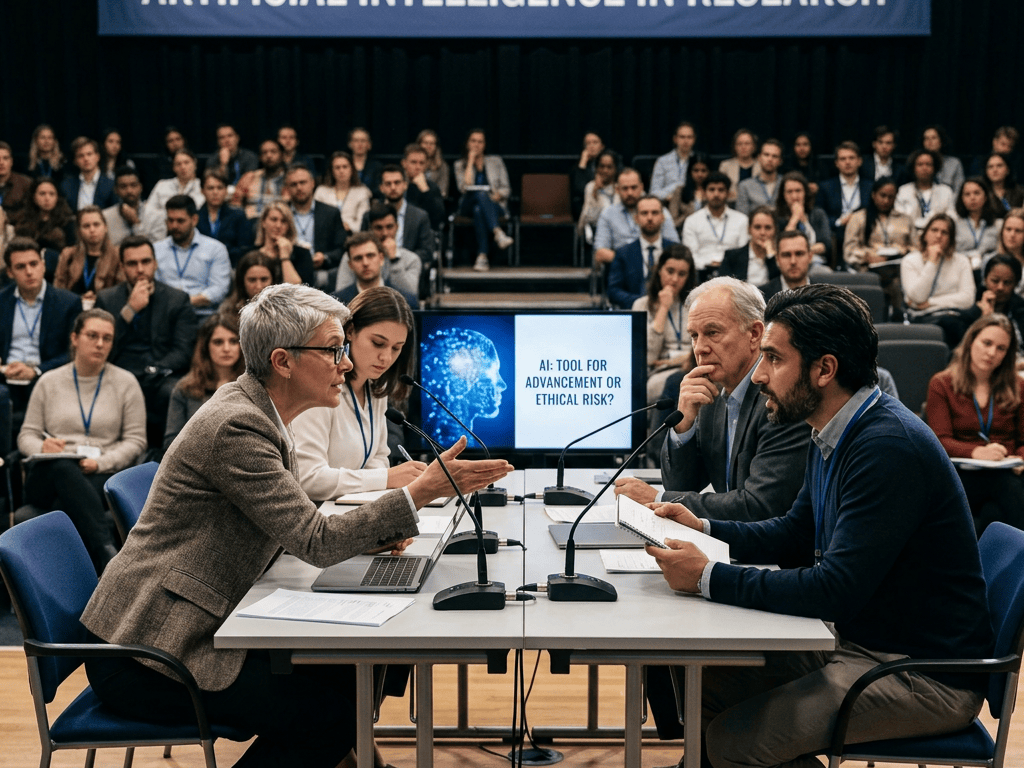
Today I return to a post I wrote last month about the AI Scare after reading Shea Vance’s report in the of The Chronicle of Higher Education on its recent survey of academics under the headline “Most Academics Haven’t Used AI to Write but Think Limited Use is OK, Chronicle Survey Finds.” It is worth reading—or at least having a bot read it or Copilot summarize it for you.
In short, 65 percent of professors said they had never used AI to prepare writing for publication, while 25 percent considered its use completely unacceptable. Altogether, 41 percent viewed it as completely or mostly unacceptable. That leaves 58 percent who supported AI assistance in at least some circumstances, including 15 percent who considered it mostly or completely acceptable; 1 percent were unsure.
Responses varied by type of writing: academics were less supportive of AI use for serious publications and journals, but more accepting of it for blogs and other pieces.
I find the resistance to AI as a writing and research tool both predictable and somewhat troubling. I came of age when research meant spending hundreds of hours—quite literally—in school or university libraries, working through massive bound indexes of periodical titles. Stack after stack pointed to recent and historical articles, books, and even microfiche related to a topic. Here is a fun 1983 video showing how to use the indexes at the Cincinnati Public Library.
Once you found a citation, you still had to locate the exact issue of the journal—either among recent issues or in annual bound volumes shelved in the stacks. The process was an ordeal. Then you had to photocopy the material, often at up to $0.10 per page, or transcribe what you needed by hand. Thus, the library was a place of considerable livelihood for students.
In high school, I worked at the Fort Garry Public Library in Winnipeg. I was not exactly the library type, but I needed a job and spent a lot of time reading. Apart from my paper route, it was my first “real” job. I loved my boss and came to enjoy the library’s quiet, relaxing atmosphere. I vividly remember my first shift, when she asked me to “read the stacks.” I asked what I should read. She smirked and explained that, in a library, “reading” means checking every shelf to ensure the books are in perfect Dewey Decimal order. It was not nearly as fun as reading, but the work became oddly mesmerizing. I would slip into a near-daze while scanning the shelves and moving misplaced books left by “those user people.” This is a primary reason libraries and department stores do not want customers returning books or pants to the shelves themselves: they know we will put them back in the wrong place.

These are distant memories from 49 years ago, when I was 15—yes, go ahead and do the math. Today, I use Google or an AI tool, specify exactly what I need, and receive a comprehensive list in return. If asked, it will generate citations and summaries for each item. I still enter the “electronic stacks” of university libraries—if I can get access without belonging to the university clique—to download full PDFs. I do this regularly when writing work of academic substance. AI now drives much of the process and I would not have it any other way.
Research that once took me hours or days in public libraries or at the University of Manitoba, Old Dominion University, and The George Washington University now takes minutes or hours. To anyone who calls this use of technology preposterous or “cheating,” I offer a challenge: shut down your computer, haul out an old 37-pound Underwood or Olivetti manual typewriter—no electric IBM Selectric from the 1980s; that would be cheating too—and pound out your paper, using Liquid Paper for corrections. Incidentally, Liquid Paper was created by the mother of Monkees guitarist Mike Nesmith.
Here is one example of how we currently use AI at the Educational Policy Institute. In our primary field research, we conduct dozens of interviews and focus groups with students, staff, and academics, producing hundreds of pages of transcripts. A typical project can exceed 500 pages, with a 45- to 60-minute interview often yielding about 20 pages. We once transcribed recordings manually, a process that took weeks; today, transcription is built into platforms such as Zoom, Google Meet, and Microsoft Teams. Transcription, however, is only the beginning. We must then code the material and identify conversational threads. Although software such as NVivo and MAXQDA is available, we have never found them particularly useful or even economically viable. Instead, we code manually in Excel, which works as well for us as the high-end commercial products—and avoids licenses that can cost thousands of dollars a year.
We have found that asking AI to review a set of interviews and produce a thematic narrative—or even a bullet list—is a better use of our time. To be candid, AI often identifies themes more effectively than we do manually; I regularly find myself saying, “We missed that.” But this is only the start. We then return to the transcripts to locate evidence that corroborates or strengthens the AI’s conclusions. Sometimes the system obscures findings or sensationalizes others, so human review of the primary material remains essential. We then revise the output to fit our narrative and draw selected findings from the AI-generated material.
And yes, I would absolutely use AI for secondary research in a journal article because it can find relevant material quickly and thoroughly—without sending me into the stacks.
Another notable finding comes from a survey of Yale’s Class of 2026: 91 percent of seniors used AI for schoolwork, and 48.5 percent used it while writing their senior theses.[1] This presents a challenging problem for teachers and professors, but it also highlights the divide between those teaching and those learning. Students are embracing the technology, while academia still contains its share of Luddites. I will not say that the 25 percent cited earlier who consider any AI use completely unacceptable are wrong, but I do not think they fully understand how it can strengthen research and reduce the drudgery of academic writing. More of us would probably write more if background tasks, including literature reviews, consumed less time. I see that as a major benefit.
In my previous Swail Letter on this subject, I emphasized AI’s importance, especially in medicine. My point is simple: we are not going back, so we need to agree on what constitutes appropriate and ethical use. Forcing academic research back into the Stone Age would be, quite literally, a step backward.
Interested in your thoughts on this very dynamic issue.
[1] https://yaledailynews.com/articles/91-percent-of-senior-class-has-used-ai-for-schoolwork-news-survey-finds.


