By Watson Scott Swail, President & Senior Research Scholar, Educational Policy Institute
There has been recent talk about TRIO programs and funding issues due to pressures from the Trump Administration. The Council for Opportunity in Education (COE) fought hard to retain their funding, which they were able to do successfully (DISCLOSURE: I served as Vice President for Research and founding Executive Director of the Pell Institute at COE back in the early OOs).
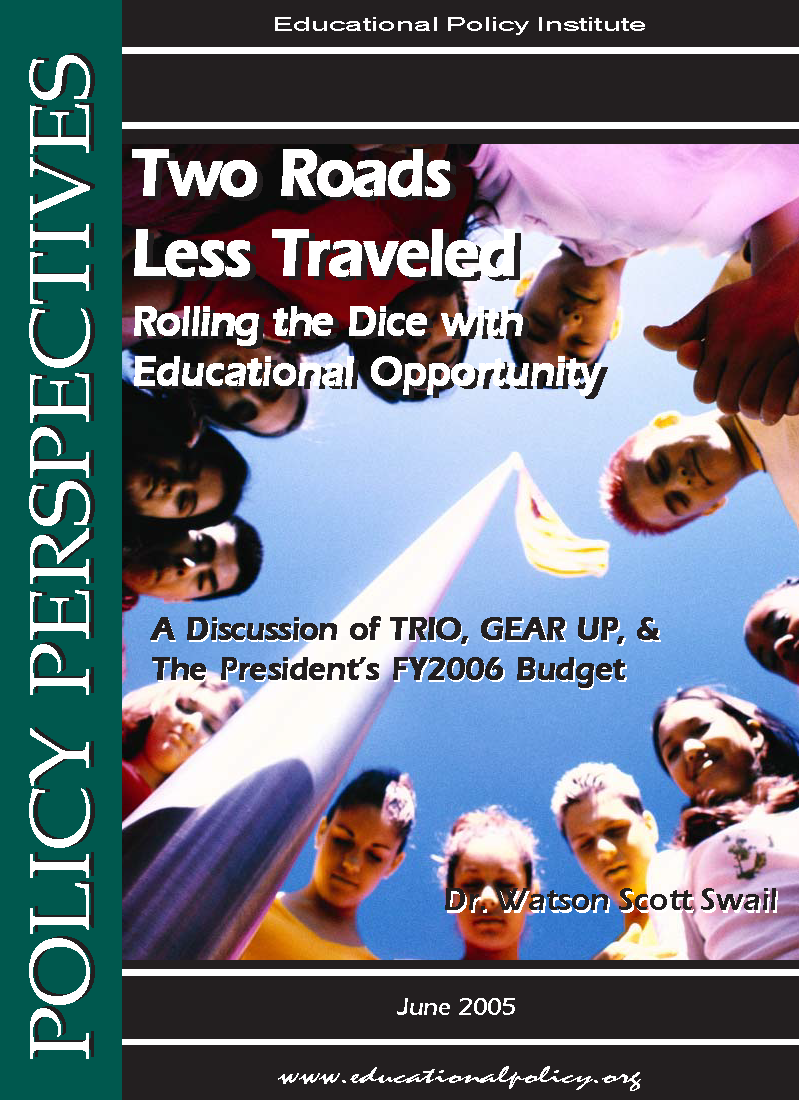
The writing below comes from a 2005 EPI publication as part of our Policy Perspectives series. This piece focused on TRIO and GEAR UP as the discussions regarding the FFY2006 were remarkably similar. For decades, Republican administrations have tried to essentially wipe out TRIO programs, only to find that many GOP lawmakers actually support the programs that operate within their schools, colleges, and constituencies.
This Policy Perspectives sounds earily reminiscent of the discussions we are currently having in Washington, including the thought of moving TRIO funding to the states (which could actually be done well if done prudently; read on). This is worth the read.
I have provided the entire text below or you can download the original publication here.
INTRODUCTION
In their FY2006 budget, the Bush Administration proposed the elimination of three popu-lar educational outreach programs targeted at low-income students: Upward Bound, Tal-ent Search, and GEAR UP. In total, this represents a cut of approximately $700 million in federal dollars. The Administration says that the money saved from these programs is to be used to support a new High School Initiative under the No Child Left Behind Act, alt-hough there are no details at present. This discussion focuses on the implications of these policy shifts on students and families, as well as educators across the United States.
Two Roads
When talking about serving needy students—those from low-income backgrounds, spe-cial education, and other, disenfranchised students—there are general two potential paths to follow. The first is to reform schools to better meet the needs of these students such that they receive a level of education that can allow them to meet their educational and career goals. The second is to provide supplementary instruction and support for these students. These efforts provide safety nets or stopgaps to help keep students in spite of the ability of schools to help all children.
The problem with the school reform model is that schools—even at their best—will never serve all students equally or equitably. It’s the way it is in a capitalist environment, espe-cially one based largely on property taxes for funding. Secondly, school “reform” isn’t exactly something that is “done,” or a point at which one “arrives.” It is a never-ending process of continuous improvement, knowing that there are always things to improve, and new theories and strategies that we come upon on our quest for excellence.
The challenge with supplementary programming is that it isn’t universal, isn’t uniformly of high quality, and is financially dependent on the wants and wanes of policymakers and philanthropists. Larry Gladieux and I wrote an article back in 1997 called “Financial Aid is Not Enough,” in which we suggested that these programs were like “Wheels of For-tune,” where students had to be lucky enough (or unlucky enough, depending on how you look at it) to be in a certain school and sometimes a certain classroom to receive services. Sometimes similarly-needy students one classroom fail to receive the much-needed aca-demic support through a program that their friends in an adjacent classroom manage to receive.
These are the two roads less traveled in serving at-risk youth, named so because we, as a society, have chosen not to adequately travel down either path. While we have dabbled with school reform, mostly with the support of special philanthropically-funded efforts, we have never done justice to implementing reforms that help students learn better and teachers teach better. Similarly, we have dabbled with intervention programs that are few and far between, let alone ill-funded.
The Bush Administration, through its FY2006 budget, is making a choice that the first road is worth traveling more than the second. Through the auspices of the No Child Left Behind Act, the Administration is suggesting that money previously earmarked for out-reach efforts will now be used to bolster school reform through NCLB. I argue that, while courageous in a political sense, this is a potentially dangerous decision for the following reasons. First, even if we could reform the schools to a level that is both adequate and absolute—which we can’t—we must be concerned with what happens to the neediest students in the time between now and the time of reformation attainment. Let’s say that by 2025, twenty years from now, we could reach this point. What happens to the millions (and it would be millions) of students each year over that period of time who would fall through the cracks because of the reduction of safety net programs to catch them? Sure, we’d still have our College Summits, AVID, MESA, and IHAD programs, but they would cover about 0.5 percent of the need at best. Even TRIO estimates it covers only 7 percent of eligible students, and it is by far the largest program nationwide. But without Upward Bound and GEAR UP, there would be little hope for these students.
Conversely, if the decision was made to solidly support supplementary programs and re-buke school reform, at least through federal funding, we would run into a similar but dif-ferent problem. While safety nets would be in place—although not at a number that would even remotely provide coverage for all needy students—we would fail to be work-ing toward a systemic solution to at least curb, if not solve, the problems that create these issues.
Most readers will understand that the obvious answer is that we have to do both. We must work toward school reform and provide safety net programs in a simultaneous fashion, and we always will. The Bush Administration, however, is saying that with their limited budget, even more limited due to ill-timed and ill-needed tax cuts, they need to make choices about how best to leverage educational reform.
Historical Role of Federal Government
Because education is a state governance issue, the federal government has had to be sur-gical in its involvement in education issues over the years. According to the US Depart-ment of Education, federal contributions account for only 10 percent of total education funding in the US. The US Department of Education accounts for only 6 percent of total education funding, and less than 3 percent of the entire federal budget.1
Since the mid-1800s, due in greatest part to the limited role of the federal government in education, intervention into education affairs has been focused on issues of importance to both the general population and special groups within that population. The passage of the Morrill Act in 1862 created the “land grant” institutions in the northern states; the second Morrill Act in 1890 established similar institutions in the southern states, in populations with special needs. These legislative packages allowed for much greater public access to higher education across the country. The passage of the Serviceman Rehabilitation Act, generally known as the “GI Bill,” in 1944, allowed thousands of returning soldiers to en-ter higher education in an affordable manner.
1 US Department of Education (http://www.ed.gov/about/overview/fed/role.html).
After the launch of Sputnik in 1957, Congress passed the National Defense Education Act (NDEA), which provided aid to all levels of education in the US, including the estab-lishment of the National Defense Student Loan Program (NDSL), now known as the Fed-eral Perkins Loan Program.
During the turbulent 1960s, Congress passed several landmark Congressional Acts that further changed the nature of federal intervention into education issues. The Civil Rights Act of 1964 forced the desegregation of public schools across the country. The Economic Opportunity Act of 1964 established the federal Upward Bound programs, providing supplementary support programs for secondary school students. And the Higher Educa-tion Act of 1965 established, among other things, Talent Search, another secondary school supplementary program aimed at talented-but-disadvantaged youth. The Elemen-tary and Secondary Education Act, also passed in 1965, provided resources to school dis-tricts serving low-income students through Head Start, bilingual education, and special education programs, among others.
The Higher Education Act of 1965 was reauthorized three years later, resulting in the ad-dition of the Student Support Services Program, which, together with Upward Bound and Talent Search, became known as the “TRIO” programs, the umbrella of which they are known today. In 1972, Congress again reauthorized the HEA, this time introducing the Basic Educational Opportunity Act (BEOG), a voucher program for postsecondary stu-dents, which would later be renamed after its presenter, Senator Claiborne Pell.
Although there were legislative antecedents, Congress authorized the Education for All Handicapped Children Act in 1975 to provide legal standing and financial support regard-ing the treatment of students with disabilities in public schools. This Act was formally changed to the Individual with Disabilities Education Act (IDEA) in 1990.
In 1998, Congress again reauthorized the Higher Education Act, introducing the Gaining Early Awareness and Readiness for Undergraduate Programs, or GEAR UP, for short. GEAR UP became a district-based supplementary program. Of course, 2001 brought with it the No Child Left Behind Act. NCLB is known most prominently for mandating ac-countability for student learning to all states, districts, and schools.
With apology for the obvious truncation of all federal efforts in education worthy of dis-cussion, this provides an overview of the more significant pieces that impact students.
The point is this: the federal government has traditionally focused its efforts on popula-tions that require special targeting and support, such as students with disabilities and low-income populations. In a “New Deal” manner, the federal government took on the role of overseer for those with little voice or power in political circles. Over the years, Congress passed laws governing the treatment of students with disabilities, through the Individuals with Disabilities Education Act (IDEA). The Elementary and Secondary Education Act (ESEA) provides over $11 billion under Title I to schools that serve high low-income students2 (Education Trust, 2005).
2 Education Trust webpage (http://www2.edtrust.org/edtrust/ESEA).
Two Programs
Upward Bound and GEAR UP are two programs that fit the traditional federal education funding pattern. Both programs target low-income students, and both programs attempt to leverage additional reforms or services at state or local levels. I will not focus on Talent Search in this article.
Upward Bound
Over the past 40 years, Upward Bound has helped millions of students identify and achieve their dreams. The program provides a number of resources and assistance for low-income students and veterans, including supplementary academic instruction in read-ing, communications, sciences, and mathematics, academic and financial counseling, tu-toring and mentoring, information about college, completion of federal financial aid forms, and work study programs. In 2002-03, there were 770 Upward Bound projects in operation across the US, plus an additional 123 Upward Bound Math & Science projects. Over 62,000 students were served through Upward Bound in that year, at an average cost in excess of $4,500 a student.
There is much anecdotal evidence of the effectiveness of Upward Bound. Each year, the Council for Opportunity in Education, the TRIO membership organization, awards TRIO Achievers Awards to former TRIO students who have made well in the real world. The list includes federal judges, prominent business men, actors, and even current members of Congress.
What there isn’t much of is empirical evidence of effectiveness. Over the 40 years of TRIO programs, there is less than a handful of federally-supported evaluation data. In fact, only the recent Upward Bound evaluation by Mathematica, one which has been un-deservingly lambasted by TRIO proponents, is the only one that has any empirical rigor. And this over a course of four decades. Hard to imagine, but true.
The Mathematica study sparked much of this episode, since the Administration has used those findings as a reason to kill the program. The study found that the program had lim-ited impact on its students when compared with a comparison group of similar students. The only statistically significant positive impact of the program was on students from very low-income families. As noted, the study has been criticized by many on the grounds of improper random assignments and other factors, but the study is most certain-ly the best of what has been done.
One major problem associated with the outcomes of the study which has never been raised is the impact of prior experience points on average outcomes across all Upward Bound projects. Prior experience points were instituted in 1980 after heavy lobbying by the Council for Opportunity in Education, then known as the National Council of Educa-tional Opportunity Associations, or NCEOA. These points are awarded to existing pro-grams in new competitions for funding, such that the competition may award up to 15 points out of 100 to a prior program. The result is that it is very difficult, and some would argue impossible, for a new project to come online without the addition of significant federal funds that allow for expansion. Not only do new programs face low odds of suc-cess, but the process often keeps programs from considering entering the competition.
We faced this head on last year during the competition for TRIO professional develop-ment programs, when a TRIO employee with the Department of Education told us that, while he thought our proposal would have merit, that we should carefully consider whether we wanted to spend the time putting together a proposal when it wouldn’t stand a chance against prior experience.
The point is that any new competition for awards is a way of separating the wheat from the chaff—the good from the bad. But prior experience points have allowed the chaff to remain in the program. In terms of a large-scale evaluation, these programs in turn coun-teract any positive impact shown by the better Upward Bound programs, causing a re-gression to the mean that limits the outcomes of the program. If many of these underper-forming programs had been eliminated, it is likely that the mean results from the study would have shifted up the scale. That’s my theory, for what it’s worth.
If we keep with a more philosophical approach to evaluating Upward Bound, we can consider pros and cons of the program as it currently resides. On the pro argument, Up-ward Bound provides support to students that many of these needy kids just do not get from their schools or communities. It provides real strategies for advancing learning in specific domains, and introduces students to the idea of college, most for the very first time. Upward Bound programs walk students and their parents through the necessary steps of planning for college, including high school course selection, career guidance, and postsecondary finances. These are important activities that first-generation, low-income students often do not get. Upward Bound, as well as Talent Search, provides an extra set of hands for some of the most challenging-but-promising students in a school. TRIO pro-fessionals are value added to a school.
On the opposite end, one of the biggest challenges of Upward Bound is that it isn’t part of a school reform model. Some like to use that against the program, and it can be argued that Upward Bound could be reformed to work more closely with schools and school re-form. But as with my prior argument, even with consideration of school reform we need supplementary programs such as Upward Bound to help fill the gaps where students leak out of the pipeline. Second, it has been argued that the overall talent of Upward Bound professionals, and Upward Bound programs, is not what it could be. Back to the discus-sion of low-achieving programs and prior experience, there is evidence of too many pro-grams and too many staffers that just aren’t up for the job. Of course, we can point to most public school districts and say the same thing. But there needs to be a better job of auditing the performance of programs and staff for excellence.
GEAR UP
GEAR UP, also know by the mouthful “Gaining Early Awareness and Readiness for Un-dergraduate Programs,” entered federal legislation as part of the 1988 reauthorization of the Higher Education Act. Congress authorized GEAR UP to encourage organizations and educational entities to provide programs targeted at low-income students that would make available financial scholarships, counseling, academic support, outreach, infor-mation about postsecondary education, and other strategies to alleviate the burdens facing these youth in the pathway to postsecondary education. The overall purpose of GEAR UP is to increase the college-going rates of low-income students.
GEAR UP is coordinated through two types of grants: state grants and partnership grants. State grants allow state agencies to coordinate their own program with local education agencies (LEAs). Partnership grants are made to collaboratives between LEAs, higher education institutions, community groups, and business/industry representatives. Since its initial year in 1999, GEAR UP has funded 288 partnership and 36 state grants, with total funding to date of $1.2 billion. Today, over a quarter of a million students are served through either a partnership or state GEAR UP grant each year.
Evidence on the effectiveness of GEAR Up is limited and mixed, in part because the original 7th grade cohort is only now in their high school senior year. The ED-sponsored longitudinal study began with 7th grade students from the 2000-01 year, and has released only one report which provides little information on students and none on their persis-tence from middle-to-high school. Another study by Penn State suggests that the program is meeting its goals, but the impact on students in academics, while positive, is very small.
There are many positive components of the GEAR UP-style of initiative. It does all the right things—tutoring, counseling, providing college information, and even professional development for teachers. It also works directly with schools, which is different than many other outreach efforts. The program is designed to leverage institutional change, which is what it should do. And it brings the community and business into the schools, broadening responsibility for learning and educational opportunity.
The challenge in GEAR UP is for the program to show much impact after all is said and done. Many large-scale grants and programs have attempted to revise schools and school systems with little long-term effect. See Annenberg, for instance. School systems are so entrenched that it is difficult to make true systemic change, and more difficult to make the change remain after funding is removed. After six years of funding, current GEAR UP programs are set to stop receiving federal funds after this year and will be on their own to continue the work started through the initiative. Knowing that this will be difficult if not impossible, the National Council on Community and Education Partnership, GEAR UP’s membership organization, has lobbied unsuccessfully to allow existing GEAR UP programs to receive renewal grants. It will be interesting to see what happens to partner-ships in the next few years.
By next year we hope to see how many students from the original cohort graduated, and how many matriculated to postsecondary education, but it is my bet that the findings will be marginal since GEAR UP manages to provide a thin-veil of services to students, since it is cast across such a wide swath of students.
Discussion
What the Future Holds for Federal Intervention. As presented earlier, the federal govern-ment is making a play to put all their marbles into school reform. While this has theoreti-cal merit, it would play out miserably in our nation’s school districts. More students would be left out in the cold, with undetermined futures.
Given that the federal government has a limited role in public K-12 education, which in-cludes college preparation, the best role for them to play is the bully pulpit and act as a lever for real reform and action. Historical federal legislation contained in the HEA, ESEA, and IDEA have effectively done that, and NCLB is the most recent example of leveraging federal resources for systematic change at the classroom level.
I have some suggestions for dealing with the current budget and TRIO and GEAR UP. With regard to the former, rather than scrapping Upward Bound and Talent Search, I suggest the federal government up the ante and do the following. First, add new safe-guards to ensure that Upward Bound and Talent Search projects across the country main-tain excellence and provide evidence of project impact. Current annual reporting is used only for basic counting and nothing else. Projects go to much trouble to collect their in-formation. Perhaps we could use it better.
Second, eliminate—or at least significantly revise—the prior experience points which allow poor projects to be renewed and potentially wonderful projects to be rejected. PEP is a bad union-mentality idea that doesn’t serve students well. If a program is worthwhile and can illustrate impact, it should be able to do that on a level-playing field.
Third, make TRIO program a federal matching program. This is the best element of GEAR UP, and TRIO programs should be treated the same way. Offer states the oppor-tunity to match dollar-for-dollar federal and state funds. This alone would double the fed-eral investment and also force states to take some ownership over the quantity and quality of programs. Each state could decide whether they wanted to ask for matching funds from institutions—public or private—to stretch the funding even further. All institutions need to be doing this type of work, whether at the pre-college, undergraduate, or graduate levels, so it would be in their interest to provide either in-kind contributions or real mon-ey. Leverage funds as far as the eye can see.
At the same time, also transfer responsibility for TRIO programs to the states, because the Department of Education has never done a decent job of coordinating the program. For those who see this as an attack on the Bush Administration, it isn’t. This has crossed every administration for the past 40 years.
And lastly if not most importantly, I’d like to see the Administration and Congress show some guts and double funding for all TRIO programs, including Student Support Ser-vices. A doubling of funding for these programs, in partnership with a dollar-for-dollar match by the states, would quadruple the funding available to help low-income students. Today’s current budget of $836 million, doubled to $1.7 billion, would then leverage
$3.4 billion in TRIO funding. Federal funding to states would be based on a formula us-ing the number of students on free- or reduced-price lunches in that state, our proxy for low-income students. In exchange for this increase, the feds can impose restrictions and conditions for the use of that money, just as the states can do the same to the institutions. It’s about accountability of public money.
Switching to GEAR UP, this program had the right idea when it was established by matching federal funds with states and partnerships and building the program as a lever
for systemic reform. It seems that the in-kind contribution of partnerships has been a problem. In projects I’ve seen, as in many federal programs, the in-kind piece is often smoke and mirrors. Of course, this isn’t true in all cases, and perhaps not in most, but I would suggest that it is true in some. Thus, I don’t suggest eliminating in-kind contribu-tions toward the partnership match, but I would suggest implementing a limit—perhaps 20 percent of the total match.
Second, get rid of the cohort approach. It sounds great for I Have a Dream, but it’s cum-bersome and complex and has the potential to leave too many kids out.
And third, provide some decent accountability for the program. The current annual re-porting requirements for the program are a start, but there have been many complaints about how the evaluation component of the program has been handled. For a program that started with a thorough look at how data would be collected and used, it rates only average in the data collection and program evaluation category.
In conclusion…
If there are issues with the programs discussed in this piece, the federal government ulti-mately deserves the blame. It is the Education Department that has designed poor evalua-tions; provided a lack of efficient safe guards for program outcomes; and not provided the leadership to achieve the goals of these programs. The theories and strategies behind Upward Bound, Talent Search, and GEAR Up are solid. We know these things work. What we need to do is ensure that we are developing the best programs in the field, and that’s what the federal government can do differently. But to simply oust these programs is not a prudent move.
In the end, this discussion may be moot in the short term. It is unlikely that members of Congress will turn their back on these programs. Republicans and Democrats alike have too much self-interest and too many constituents to eliminate small programs that held needy students. Politically, zeroing out these programs it’s a non-starter, and the general thought on it at this point is just that.
But these shots-off-the-bow from the Administration are clear warning signs that some change has to take place. If TRIO and GEAR UP programs take solace in winning the FY2006 budget war, they should be warned that this is only the first attack. Any program that can’t show true impact is walking a short plank off the starboard side.
The Bush Administration is being bold through their proposed budget, and in many in-stances they will likely lose. But it is ultimately up to the TRIO and GEAR UP staff and leadership to ensure that future projects are held to a high standard. Otherwise, these pro-grams will disappear someday—soon.
* * * *


