
by Dr. Watson Scott Swail, President & Senior Research Scientist
I grew up at a special, prosperous time in history. Born in the early 60s, I didn’t have the burden of living through a world war. In fact, we didn’t think of war much in my youth. Raised in Canada, Vietnam wasn’t our issue. We read about it. But because it wasn’t us, it mattered less than it did to our southern friends in the US who were under conscription. Canada gained a lot of American “professors” during those years.
My youth included banana seats, Evil Knievel, disco and new wave, and the massive expansion of fast food. Going to “Mickey Ds” on Pembina Highway was a big deal, as was a bucket of chicken from KFC, which we affectionally called “Champs” in Winnipeg.
When I graduated from high school, I immediately enrolled in university. My brothers and I were first gen students, although Dad had one year of university on record. We knew we had the opportunity to go and that we likely would. It wasn’t in too much doubt.
Going to university meant going locally. I didn’t know anyone who left Winnipeg to go to university, although I found out later that people did; just no one I knew. We had two local universities: the University of Manitoba and the University of Winnipeg. The U of M was equivalent to a land-grant university in the US. Although it is a comprehensive institution, it still has an agricultural base and serves approximately 32,000 students, 20 percent of whom are international from 123 countries.
I see 1980 as the golden age of postsecondary education. I may be bias, but I’ll let the factors speak for themselves. When I enrolled at the U of M in fall 1980, cost wasn’t a limiting factor. We were in the middle of the middle class. Not poor. Not affluent. Comfortable. My tuition was $900 for the entire year, which I paid myself. My parents had an agreement that they would let us live at home, which was three miles away from the university, and we would pay everything else. We had use of a car, although we all ended up acquiring our own vehicles sometime during university.
I covered the $900 cost the way a lot of students did: through several part-time jobs and summer work. During the school year I worked at a local ski shop and also served as a DJ for parties, “socials,” and weddings. The province set up special funds to help support summer employment for university/college students.[1] Thus, I worked for a “student painting” business before ultimately starting my own student painting business. That was my first real business.
The sum of $900 wasn’t horrible in terms of ability to pay. Even in today’s dollars, my 1980 tuition translates to about $3,500. It is difficult if not impossible to find a university or college anywhere today where the annual tuition is only $3,500, let alone $10,000. Well, to be fair, tuition at the U of M today is still only $6,500 Canadian, equivalent to about US $4,700. Comparatively, the cost of tuition at Old Dominion University, my master’s degree alma mater, is approximately US $13,000 (CDN $18,000). On their website, ODU lists tuition charges for in-state students as $281/credit hour. However, they also add a whopping $154/credit hour charge for “auxiliary tuition” (student facilities, recreation and allied services), as well as these fees: general services fee $18/semester; student health fee $170/semester; transportation fee $63/semester; “Innovation Fee” (not making this up) $5/credit hour for campus tech; ID card fee of $4/semester; “Commonwealth Capital Fee” $17,50/credit hour; student transition fee of $75. ODU estimates textbooks at $655/semester. Those fees are how $281/credit hour gets to $13,000. This doesn’t include room and board, of course. Analysts and economists argue that living fees are paid whether one is in college or at work.
The rapid rise in prices at universities is complicated by the relatively large increases in other costs. The Consumer Price Index (CPI), our inflationary measure from the Bureau of Labor Statistics (BLS), rose 304 percent between 1980 and 2026. Still, tuition and fee charges rose approximately 690 percent; more than double that of inflation. If pegged to inflation, tuition and fees in the US would average somewhere between $6,000 to $7,000, not the $13,000 I’ve referenced herein. The kicker is that median household income rose only 206 percent, from $21,020 to $64,220—significantly lower than average CPI increases. Thus, ability to pay is an increasingly complex and devastating issue for many Americans and Canadians.
Here are some other “market basket” items I cherry-picked:
- Rent and housing prices escalated at rates and values that we would have thought “unbelievable” back in the 70s and 80s. Rent is the one of the biggest challenges today with an average monthly cost of just under $1,700/month, up 605 percent from $241 in 1980. Housing increased 525 percent from a median home sales price of $64,450 in 1980 to $403,000 during the first quarter of 2026.
- The Big Mac increased 599 percent from $1.20 to $8.39 (I literally found that number on McDonald’s site this morning). This is an interesting one because the Big Mac is somewhat infamous in economic circles as the “Big Mac Index,” which is used to compare relative cost of living around the world due to the ubiquity of McDonalds restaurants globally. Certainly not a perfect measure, but for economists, this is the height of their collective humor. Sad, but true. See here for details. I have used the BMI in my work.
- The average car price rose 534 percent. Back in 1980, a car cost $7,500. Today, people are shelling out $48,000 for a new vehicle.
- A movie ticket that cost $2.69 in 1980 now costs $16, an increase of 495 percent. I’ll spare readers the cost of popcorn and drinks (note: it’s way worse…).
- Gas has gone up 236 percent—less than inflation—and includes the recent increases due to the Iran War. Who knew?
- Pizzas also up less than inflation, which surprised me. The average cost of a cheese pizza is $18 right now; although my medium pizza the other night tapped out at $26.
As Dave Breneman, an economist and former college president once told me, higher education is in a group of market basket items that always is and always will be pegged above inflation, similar to health care and similar commodities and services. This is a big problem for college access and equity as the ability for taxpayers, families, and students to keep up with these increasing costs is being crunched. It was a bad situation back in the 1990s when I started researching college affordability issues at The Washington Office of The College Board. And it’s only gotten worse in the 30 years since then with no end and no solution in sight. It was a clarion call back then; today, I don’t hear the argument stated with a whole lot of commitment or urgency. That perhaps is a bigger issue.
What was your tuition when you were first in college?
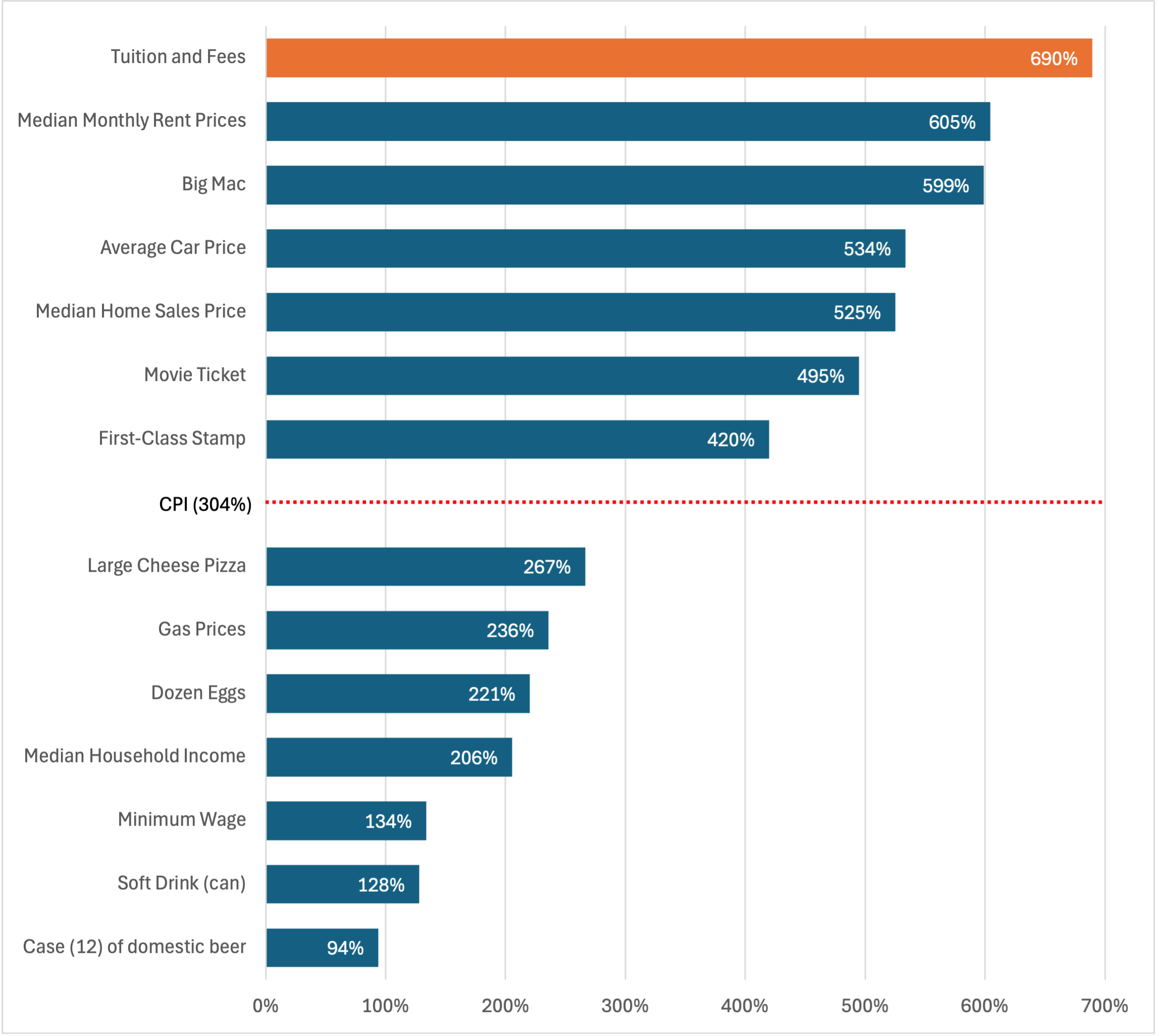
NOTE: Data are from a plethora of sites collected by the author on May 15, 2026.
| Item | 1980 | 2026 | Increase (%) |
| Quart of Milk | 0.93 | 1.79 | 92% |
| Case (12) of domestic beer | 6.70 | 13.00 | 94% |
| Soft Drink (can) | 0.25 | 0.57 | 128% |
| Minimum Wage | 3.10 | 7.25 | 134% |
| Median Household Income | 21,020 | 64,220 | 206% |
| Dozen Eggs | 0.78 | 2.50 | 221% |
| Gas Prices | 1.25 | 4.20 | 236% |
| Large Cheese Pizza | 5.00 | 18.33 | 267% |
| CPI | 1.00 | 4.04 | 304% |
| First-Class Stamp | 0.15 | 0.78 | 420% |
| Movie Ticket | 2.69 | 16.00 | 495% |
| Median Home Sales Price | 64,450 | 403,000 | 525% |
| Average Car Price | 7,574 | 48,000 | 534% |
| Big Mac | 1.20 | 8.39 | 599% |
| Median Monthly Rent Prices | 241 | 1,698 | 605% |
| Tuition and Fees | 1,679 | 13,257 | 690% |
[1] Note that in Canada, the term “college” refers only to two-year institutions, while four-year institutions are always referred to as “universities.”


